𝗙𝗢𝗢𝗗 𝗙𝗢𝗥 𝗧𝗛𝗢𝗨𝗚𝗛𝗧 - 𝗜𝗞𝗔-𝟯𝟭 𝗔𝗥𝗔𝗪.

🇵🇭 𝗙𝗜𝗟𝗜𝗣𝗜𝗡𝗢

𝗣𝗔𝗚𝗞𝗔𝗧𝗔𝗣𝗨𝗦 𝗠𝗔𝗚𝗜𝗦𝗜𝗣, 𝗞𝗜𝗟𝗢𝗦 𝗡𝗔


Sa loob ng 30 araw, nagtanong-tanong tayo.

Hinamon natin ang mga palagay.
Sinuri natin ang tiwala.
Tinalakay natin ang pananagutan.
Tinalakay natin ang pamumuno, mga patakaran, katarungan, katapatan, at pagtutulungan.

At kahapon, nagtapos tayo sa isang paanyaya:

Mag-isip nang sarili.
Magtanong.
Maging tagabuo.

Kaya ano ang mangyayari ngayon?

Magsisimula tayong muli.

Hindi sa pamamagitan ng isa pang malaking pangako.
Hindi sa pamamagitan ng isa pang islogan.

Kundi sa pamamagitan ng isang simpleng prinsipyo:

𝐀𝐍𝐆 𝐈𝐒𝐈𝐏 𝐀𝐘 𝐌𝐀𝐘 𝐇𝐀𝐋𝐀𝐆𝐀 𝐊𝐀𝐏𝐀𝐆 𝐍𝐀𝐁𝐀𝐁𝐀𝐆𝐎 𝐀𝐍𝐆 𝐀𝐓𝐈𝐍𝐆 𝐆𝐀𝐖𝐀.


Ang binhi ay mananatiling binhi hangga't walang nagtatanim nito.
Ang ideya ay mananatiling ideya hangga't walang sumusubok nito.
Ang pangitain ay mananatiling pangarap hangga't hindi nagkakaisa ang mga tao upang isakatuparan ito.

At dito nagsisimula ang susunod na kabanata.

𝙈𝙐𝙇𝘼 𝙎𝘼 𝙋𝘼𝙂-𝙄𝙄𝙎𝙄𝙋 → 𝙋𝘼𝙂𝙆𝙄𝙇𝙊𝙎.

Ngunit ang pagkilos ay hindi nangangahulugang pagmamadali.

Ito ay nangangahulugang:

Subok bago magtiwala.
Itala bago mag-angkin.
Makinig bago magpasya.
Itama bago palawakin.
Buuin bago mangako.
At isama ang mga tao bago magsalita para sa kanila.

Ganyan nagiging sistema ang isang ideya.

At marahil iyan ang tunay na aral ng ating unang 30 araw:

Hindi natin kailangan na ang lahat ay maniwala sa unang araw.
Kailangan natin ng sapat na tao na handang mag-isip, magtanong, sumubok, at bumuo.

Kaya, mga kaibigan, mambabasa at tagasunod

Ika-30 araw ang nagbigay ng paanyaya.
Ika-31 araw ang nagbibigay ng unang hakbang.

𝙈𝘼𝙂𝙏𝘼𝙔𝙊 𝙏𝘼𝙔𝙊.

Hindi bukas.
Hindi balang araw.

Isang maliit at nasusuring hakbang sa bawat pagkakataon.

𝐏𝐀𝐆𝐊𝐀𝐈𝐍 𝐏𝐀𝐍𝐆 𝐈𝐒𝐈𝐏 — 𝐀𝐑𝐀𝐖 𝟑𝟏
𝐀𝐧𝐠 𝐩𝐚𝐠-𝐢𝐢𝐬𝐢𝐩 𝐚𝐲 𝐧𝐚𝐠𝐩𝐚𝐩𝐚𝐭𝐮𝐥𝐨𝐲. 𝐀𝐧𝐠 𝐩𝐚𝐠𝐭𝐚𝐭𝐚𝐲𝐨 𝐚𝐲 𝐧𝐚𝐠𝐬𝐢𝐬𝐢𝐦𝐮𝐥𝐚.

— 𝕬𝖗𝖘𝖊𝖓𝖎𝖔 𝕱𝖊𝖗𝖒𝖆𝖓𝖙𝖊𝖟 𝕬𝖓𝖙𝖔𝖓𝖎𝖔
Pangkalahatang Tagapamagitan ng Pamumuno, PAMANA–ECPP

𝙎𝙖𝙢𝙖𝙝𝙖𝙣 𝙠𝙖𝙢𝙞. 𝙈𝙖𝙜𝙞𝙣𝙜 𝙖𝙣𝙜 𝙥𝙖𝙜𝙗𝙖𝙗𝙖𝙜𝙤. 𝙇𝙪𝙢𝙞𝙠𝙝𝙖 𝙣𝙖 𝙖𝙡𝙤𝙣. 𝘼𝙣𝙜 𝙥𝙖𝙣𝙖𝙝𝙤𝙣 𝙥𝙖𝙧𝙖 𝙨𝙖 𝙞𝙨𝙖𝙣𝙜 𝙩𝙪𝙣𝙖𝙮 𝙣𝙖 𝙢𝙖𝙨𝙖𝙜𝙖𝙣𝙖𝙣𝙜 𝙗𝙪𝙝𝙖𝙮, 𝙥𝙖𝙧𝙖 𝙨𝙖 𝙡𝙖𝙝𝙖𝙩 𝙖𝙮 𝙣𝙜𝙖𝙮𝙤𝙣 𝙣𝙖.

🙏 𝙈𝙖𝙧𝙖𝙢𝙞𝙣𝙜 𝙨𝙖𝙡𝙖𝙢𝙖𝙩 𝙨𝙖 𝙥𝙖𝙜𝙗𝙖𝙗𝙖𝙨𝙖 𝙖𝙩 𝙨𝙖 𝙥𝙖𝙜𝙜𝙖𝙬𝙖 𝙣𝙜 𝙨𝙪𝙨𝙪𝙣𝙤𝙙 𝙣𝙖 𝙝𝙖𝙠𝙗𝙖𝙣𝙜 𝙩𝙪𝙣𝙜𝙤 𝙨𝙖 𝙠𝙖𝙨𝙖𝙜𝙖𝙣𝙖𝙖𝙣!

📸: Arsenio Antonio | Arcie Antonio, 𝑮𝒍𝒐𝒃𝒂𝒍 𝑳𝒆𝒂𝒅 𝑪𝒐𝒐𝒓𝒅𝒊𝒏𝒂𝒕𝒐𝒓

Francisco Leonor | Francisco Leonor , 𝑹𝒆𝒈𝒊𝒐𝒏𝒂𝒍 𝑴𝒂𝒏𝒂𝒈𝒆𝒓

ECPP European Community Projects Philippines

https://mybossmedia.com/

ECPP European Community Projects Philippines (German Community), Container house Community Projects. Isang proyekto ng 𝑫𝑻𝑪𝑴 𝑮𝒓𝒐𝒖𝒑 𝑰𝒏𝒄. Nangunguna sa pagtataguyod ng mga Etikal na Pamumuhunan.

Ang G5-G64 Cooperative System ay isang Intelektwal na Ari-arian ng 𝑫𝑻𝑪𝑴 𝑮𝒓𝒐𝒖𝒑 𝑰𝒏𝒄. Lahat ng Karapatan ay Nakalaan.


image

𝗙𝗢𝗢𝗗 𝗙𝗢𝗥 𝗧𝗛𝗢𝗨𝗚𝗛𝗧 - 𝗜𝗞𝗔-𝟯𝟭 𝗔𝗥𝗔𝗪.

🇵🇭 𝗙𝗜𝗟𝗜𝗣𝗜𝗡𝗢

𝗣𝗔𝗚𝗞𝗔𝗧𝗔𝗣𝗨𝗦 𝗠𝗔𝗚𝗜𝗦𝗜𝗣, 𝗞𝗜𝗟𝗢𝗦 𝗡𝗔


Sa loob ng 30 araw, nagtanong-tanong tayo.

Hinamon natin ang mga palagay.
Sinuri natin ang tiwala.
Tinalakay natin ang pananagutan.
Tinalakay natin ang pamumuno, mga patakaran, katarungan, katapatan, at pagtutulungan.

At kahapon, nagtapos tayo sa isang paanyaya:

Mag-isip nang sarili.
Magtanong.
Maging tagabuo.

Kaya ano ang mangyayari ngayon?

Magsisimula tayong muli.

Hindi sa pamamagitan ng isa pang malaking pangako.
Hindi sa pamamagitan ng isa pang islogan.

Kundi sa pamamagitan ng isang simpleng prinsipyo:

𝐀𝐍𝐆 𝐈𝐒𝐈𝐏 𝐀𝐘 𝐌𝐀𝐘 𝐇𝐀𝐋𝐀𝐆𝐀 𝐊𝐀𝐏𝐀𝐆 𝐍𝐀𝐁𝐀𝐁𝐀𝐆𝐎 𝐀𝐍𝐆 𝐀𝐓𝐈𝐍𝐆 𝐆𝐀𝐖𝐀.


Ang binhi ay mananatiling binhi hangga't walang nagtatanim nito.
Ang ideya ay mananatiling ideya hangga't walang sumusubok nito.
Ang pangitain ay mananatiling pangarap hangga't hindi nagkakaisa ang mga tao upang isakatuparan ito.

At dito nagsisimula ang susunod na kabanata.

𝙈𝙐𝙇𝘼 𝙎𝘼 𝙋𝘼𝙂-𝙄𝙄𝙎𝙄𝙋 → 𝙋𝘼𝙂𝙆𝙄𝙇𝙊𝙎.

Ngunit ang pagkilos ay hindi nangangahulugang pagmamadali.

Ito ay nangangahulugang:

Subok bago magtiwala.
Itala bago mag-angkin.
Makinig bago magpasya.
Itama bago palawakin.
Buuin bago mangako.
At isama ang mga tao bago magsalita para sa kanila.

Ganyan nagiging sistema ang isang ideya.

At marahil iyan ang tunay na aral ng ating unang 30 araw:

Hindi natin kailangan na ang lahat ay maniwala sa unang araw.
Kailangan natin ng sapat na tao na handang mag-isip, magtanong, sumubok, at bumuo.

Kaya, mga kaibigan, mambabasa at tagasunod

Ika-30 araw ang nagbigay ng paanyaya.
Ika-31 araw ang nagbibigay ng unang hakbang.

𝙈𝘼𝙂𝙏𝘼𝙔𝙊 𝙏𝘼𝙔𝙊.

Hindi bukas.
Hindi balang araw.

Isang maliit at nasusuring hakbang sa bawat pagkakataon.

𝐏𝐀𝐆𝐊𝐀𝐈𝐍 𝐏𝐀𝐍𝐆 𝐈𝐒𝐈𝐏 — 𝐀𝐑𝐀𝐖 𝟑𝟏
𝐀𝐧𝐠 𝐩𝐚𝐠-𝐢𝐢𝐬𝐢𝐩 𝐚𝐲 𝐧𝐚𝐠𝐩𝐚𝐩𝐚𝐭𝐮𝐥𝐨𝐲. 𝐀𝐧𝐠 𝐩𝐚𝐠𝐭𝐚𝐭𝐚𝐲𝐨 𝐚𝐲 𝐧𝐚𝐠𝐬𝐢𝐬𝐢𝐦𝐮𝐥𝐚.

— 𝕬𝖗𝖘𝖊𝖓𝖎𝖔 𝕱𝖊𝖗𝖒𝖆𝖓𝖙𝖊𝖟 𝕬𝖓𝖙𝖔𝖓𝖎𝖔
Pangkalahatang Tagapamagitan ng Pamumuno, PAMANA–ECPP

𝙎𝙖𝙢𝙖𝙝𝙖𝙣 𝙠𝙖𝙢𝙞. 𝙈𝙖𝙜𝙞𝙣𝙜 𝙖𝙣𝙜 𝙥𝙖𝙜𝙗𝙖𝙗𝙖𝙜𝙤. 𝙇𝙪𝙢𝙞𝙠𝙝𝙖 𝙣𝙖 𝙖𝙡𝙤𝙣. 𝘼𝙣𝙜 𝙥𝙖𝙣𝙖𝙝𝙤𝙣 𝙥𝙖𝙧𝙖 𝙨𝙖 𝙞𝙨𝙖𝙣𝙜 𝙩𝙪𝙣𝙖𝙮 𝙣𝙖 𝙢𝙖𝙨𝙖𝙜𝙖𝙣𝙖𝙣𝙜 𝙗𝙪𝙝𝙖𝙮, 𝙥𝙖𝙧𝙖 𝙨𝙖 𝙡𝙖𝙝𝙖𝙩 𝙖𝙮 𝙣𝙜𝙖𝙮𝙤𝙣 𝙣𝙖.

🙏 𝙈𝙖𝙧𝙖𝙢𝙞𝙣𝙜 𝙨𝙖𝙡𝙖𝙢𝙖𝙩 𝙨𝙖 𝙥𝙖𝙜𝙗𝙖𝙗𝙖𝙨𝙖 𝙖𝙩 𝙨𝙖 𝙥𝙖𝙜𝙜𝙖𝙬𝙖 𝙣𝙜 𝙨𝙪𝙨𝙪𝙣𝙤𝙙 𝙣𝙖 𝙝𝙖𝙠𝙗𝙖𝙣𝙜 𝙩𝙪𝙣𝙜𝙤 𝙨𝙖 𝙠𝙖𝙨𝙖𝙜𝙖𝙣𝙖𝙖𝙣!

📸: Arsenio Antonio | Arcie Antonio, 𝑮𝒍𝒐𝒃𝒂𝒍 𝑳𝒆𝒂𝒅 𝑪𝒐𝒐𝒓𝒅𝒊𝒏𝒂𝒕𝒐𝒓

Francisco Leonor | Francisco Leonor , 𝑹𝒆𝒈𝒊𝒐𝒏𝒂𝒍 𝑴𝒂𝒏𝒂𝒈𝒆𝒓

ECPP European Community Projects Philippines

https://mybossmedia.com/

ECPP European Community Projects Philippines (German Community), Container house Community Projects. Isang proyekto ng 𝑫𝑻𝑪𝑴 𝑮𝒓𝒐𝒖𝒑 𝑰𝒏𝒄. Nangunguna sa pagtataguyod ng mga Etikal na Pamumuhunan.

Ang G5-G64 Cooperative System ay isang Intelektwal na Ari-arian ng 𝑫𝑻𝑪𝑴 𝑮𝒓𝒐𝒖𝒑 𝑰𝒏𝒄. Lahat ng Karapatan ay Nakalaan.

MyBossMedia
mybossmedia.com

MyBossMedia

MyBossMedia is a Social Networking Platform. With our new feature, users can publish posts, photos, and more.
imageimage

𝗙𝗢𝗢𝗗 𝗙𝗢𝗥 𝗧𝗛𝗢𝗨𝗚𝗛𝗧 - 𝗜𝗞𝗔-𝟯𝟭 𝗔𝗥𝗔𝗪.

🇵🇭 𝗙𝗜𝗟𝗜𝗣𝗜𝗡𝗢

𝗣𝗔𝗚𝗞𝗔𝗧𝗔𝗣𝗨𝗦 𝗠𝗔𝗚𝗜𝗦𝗜𝗣, 𝗞𝗜𝗟𝗢𝗦 𝗡𝗔


Sa loob ng 30 araw, nagtanong-tanong tayo.

Hinamon natin ang mga palagay.
Sinuri natin ang tiwala.
Tinalakay natin ang pananagutan.
Tinalakay natin ang pamumuno, mga patakaran, katarungan, katapatan, at pagtutulungan.

At kahapon, nagtapos tayo sa isang paanyaya:

Mag-isip nang sarili.
Magtanong.
Maging tagabuo.

Kaya ano ang mangyayari ngayon?

Magsisimula tayong muli.

Hindi sa pamamagitan ng isa pang malaking pangako.
Hindi sa pamamagitan ng isa pang islogan.

Kundi sa pamamagitan ng isang simpleng prinsipyo:

𝐀𝐍𝐆 𝐈𝐒𝐈𝐏 𝐀𝐘 𝐌𝐀𝐘 𝐇𝐀𝐋𝐀𝐆𝐀 𝐊𝐀𝐏𝐀𝐆 𝐍𝐀𝐁𝐀𝐁𝐀𝐆𝐎 𝐀𝐍𝐆 𝐀𝐓𝐈𝐍𝐆 𝐆𝐀𝐖𝐀.


Ang binhi ay mananatiling binhi hangga't walang nagtatanim nito.
Ang ideya ay mananatiling ideya hangga't walang sumusubok nito.
Ang pangitain ay mananatiling pangarap hangga't hindi nagkakaisa ang mga tao upang isakatuparan ito.

At dito nagsisimula ang susunod na kabanata.

𝙈𝙐𝙇𝘼 𝙎𝘼 𝙋𝘼𝙂-𝙄𝙄𝙎𝙄𝙋 → 𝙋𝘼𝙂𝙆𝙄𝙇𝙊𝙎.

Ngunit ang pagkilos ay hindi nangangahulugang pagmamadali.

Ito ay nangangahulugang:

Subok bago magtiwala.
Itala bago mag-angkin.
Makinig bago magpasya.
Itama bago palawakin.
Buuin bago mangako.
At isama ang mga tao bago magsalita para sa kanila.

Ganyan nagiging sistema ang isang ideya.

At marahil iyan ang tunay na aral ng ating unang 30 araw:

Hindi natin kailangan na ang lahat ay maniwala sa unang araw.
Kailangan natin ng sapat na tao na handang mag-isip, magtanong, sumubok, at bumuo.

Kaya, mga kaibigan, mambabasa at tagasunod

Ika-30 araw ang nagbigay ng paanyaya.
Ika-31 araw ang nagbibigay ng unang hakbang.

𝙈𝘼𝙂𝙏𝘼𝙔𝙊 𝙏𝘼𝙔𝙊.

Hindi bukas.
Hindi balang araw.

Isang maliit at nasusuring hakbang sa bawat pagkakataon.

𝐏𝐀𝐆𝐊𝐀𝐈𝐍 𝐏𝐀𝐍𝐆 𝐈𝐒𝐈𝐏 — 𝐀𝐑𝐀𝐖 𝟑𝟏
𝐀𝐧𝐠 𝐩𝐚𝐠-𝐢𝐢𝐬𝐢𝐩 𝐚𝐲 𝐧𝐚𝐠𝐩𝐚𝐩𝐚𝐭𝐮𝐥𝐨𝐲. 𝐀𝐧𝐠 𝐩𝐚𝐠𝐭𝐚𝐭𝐚𝐲𝐨 𝐚𝐲 𝐧𝐚𝐠𝐬𝐢𝐬𝐢𝐦𝐮𝐥𝐚.

— 𝕬𝖗𝖘𝖊𝖓𝖎𝖔 𝕱𝖊𝖗𝖒𝖆𝖓𝖙𝖊𝖟 𝕬𝖓𝖙𝖔𝖓𝖎𝖔
Pangkalahatang Tagapamagitan ng Pamumuno, PAMANA–ECPP

𝙎𝙖𝙢𝙖𝙝𝙖𝙣 𝙠𝙖𝙢𝙞. 𝙈𝙖𝙜𝙞𝙣𝙜 𝙖𝙣𝙜 𝙥𝙖𝙜𝙗𝙖𝙗𝙖𝙜𝙤. 𝙇𝙪𝙢𝙞𝙠𝙝𝙖 𝙣𝙖 𝙖𝙡𝙤𝙣. 𝘼𝙣𝙜 𝙥𝙖𝙣𝙖𝙝𝙤𝙣 𝙥𝙖𝙧𝙖 𝙨𝙖 𝙞𝙨𝙖𝙣𝙜 𝙩𝙪𝙣𝙖𝙮 𝙣𝙖 𝙢𝙖𝙨𝙖𝙜𝙖𝙣𝙖𝙣𝙜 𝙗𝙪𝙝𝙖𝙮, 𝙥𝙖𝙧𝙖 𝙨𝙖 𝙡𝙖𝙝𝙖𝙩 𝙖𝙮 𝙣𝙜𝙖𝙮𝙤𝙣 𝙣𝙖.

🙏 𝙈𝙖𝙧𝙖𝙢𝙞𝙣𝙜 𝙨𝙖𝙡𝙖𝙢𝙖𝙩 𝙨𝙖 𝙥𝙖𝙜𝙗𝙖𝙗𝙖𝙨𝙖 𝙖𝙩 𝙨𝙖 𝙥𝙖𝙜𝙜𝙖𝙬𝙖 𝙣𝙜 𝙨𝙪𝙨𝙪𝙣𝙤𝙙 𝙣𝙖 𝙝𝙖𝙠𝙗𝙖𝙣𝙜 𝙩𝙪𝙣𝙜𝙤 𝙨𝙖 𝙠𝙖𝙨𝙖𝙜𝙖𝙣𝙖𝙖𝙣!

📸: Arsenio Antonio | Arcie Antonio, 𝑮𝒍𝒐𝒃𝒂𝒍 𝑳𝒆𝒂𝒅 𝑪𝒐𝒐𝒓𝒅𝒊𝒏𝒂𝒕𝒐𝒓

Francisco Leonor | Francisco Leonor , 𝑹𝒆𝒈𝒊𝒐𝒏𝒂𝒍 𝑴𝒂𝒏𝒂𝒈𝒆𝒓

ECPP European Community Projects Philippines

https://mybossmedia.com/

ECPP European Community Projects Philippines (German Community), Container house Community Projects. Isang proyekto ng 𝑫𝑻𝑪𝑴 𝑮𝒓𝒐𝒖𝒑 𝑰𝒏𝒄. Nangunguna sa pagtataguyod ng mga Etikal na Pamumuhunan.

Ang G5-G64 Cooperative System ay isang Intelektwal na Ari-arian ng 𝑫𝑻𝑪𝑴 𝑮𝒓𝒐𝒖𝒑 𝑰𝒏𝒄. Lahat ng Karapatan ay Nakalaan.

image

𝗙𝗢𝗢𝗗 𝗙𝗢𝗥 𝗧𝗛𝗢𝗨𝗚𝗛𝗧 - 𝗜𝗞𝗔-𝟯𝟭 𝗔𝗥𝗔𝗪.

🇵🇭 𝗙𝗜𝗟𝗜𝗣𝗜𝗡𝗢

𝗣𝗔𝗚𝗞𝗔𝗧𝗔𝗣𝗨𝗦 𝗠𝗔𝗚𝗜𝗦𝗜𝗣, 𝗞𝗜𝗟𝗢𝗦 𝗡𝗔


Sa loob ng 30 araw, nagtanong-tanong tayo.

Hinamon natin ang mga palagay.
Sinuri natin ang tiwala.
Tinalakay natin ang pananagutan.
Tinalakay natin ang pamumuno, mga patakaran, katarungan, katapatan, at pagtutulungan.

At kahapon, nagtapos tayo sa isang paanyaya:

Mag-isip nang sarili.
Magtanong.
Maging tagabuo.

Kaya ano ang mangyayari ngayon?

Magsisimula tayong muli.

Hindi sa pamamagitan ng isa pang malaking pangako.
Hindi sa pamamagitan ng isa pang islogan.

Kundi sa pamamagitan ng isang simpleng prinsipyo:

𝐀𝐍𝐆 𝐈𝐒𝐈𝐏 𝐀𝐘 𝐌𝐀𝐘 𝐇𝐀𝐋𝐀𝐆𝐀 𝐊𝐀𝐏𝐀𝐆 𝐍𝐀𝐁𝐀𝐁𝐀𝐆𝐎 𝐀𝐍𝐆 𝐀𝐓𝐈𝐍𝐆 𝐆𝐀𝐖𝐀.


Ang binhi ay mananatiling binhi hangga't walang nagtatanim nito.
Ang ideya ay mananatiling ideya hangga't walang sumusubok nito.
Ang pangitain ay mananatiling pangarap hangga't hindi nagkakaisa ang mga tao upang isakatuparan ito.

At dito nagsisimula ang susunod na kabanata.

𝙈𝙐𝙇𝘼 𝙎𝘼 𝙋𝘼𝙂-𝙄𝙄𝙎𝙄𝙋 → 𝙋𝘼𝙂𝙆𝙄𝙇𝙊𝙎.

Ngunit ang pagkilos ay hindi nangangahulugang pagmamadali.

Ito ay nangangahulugang:

Subok bago magtiwala.
Itala bago mag-angkin.
Makinig bago magpasya.
Itama bago palawakin.
Buuin bago mangako.
At isama ang mga tao bago magsalita para sa kanila.

Ganyan nagiging sistema ang isang ideya.

At marahil iyan ang tunay na aral ng ating unang 30 araw:

Hindi natin kailangan na ang lahat ay maniwala sa unang araw.
Kailangan natin ng sapat na tao na handang mag-isip, magtanong, sumubok, at bumuo.

Kaya, mga kaibigan, mambabasa at tagasunod

Ika-30 araw ang nagbigay ng paanyaya.
Ika-31 araw ang nagbibigay ng unang hakbang.

𝙈𝘼𝙂𝙏𝘼𝙔𝙊 𝙏𝘼𝙔𝙊.

Hindi bukas.
Hindi balang araw.

Isang maliit at nasusuring hakbang sa bawat pagkakataon.

𝐏𝐀𝐆𝐊𝐀𝐈𝐍 𝐏𝐀𝐍𝐆 𝐈𝐒𝐈𝐏 — 𝐀𝐑𝐀𝐖 𝟑𝟏
𝐀𝐧𝐠 𝐩𝐚𝐠-𝐢𝐢𝐬𝐢𝐩 𝐚𝐲 𝐧𝐚𝐠𝐩𝐚𝐩𝐚𝐭𝐮𝐥𝐨𝐲. 𝐀𝐧𝐠 𝐩𝐚𝐠𝐭𝐚𝐭𝐚𝐲𝐨 𝐚𝐲 𝐧𝐚𝐠𝐬𝐢𝐬𝐢𝐦𝐮𝐥𝐚.

— 𝕬𝖗𝖘𝖊𝖓𝖎𝖔 𝕱𝖊𝖗𝖒𝖆𝖓𝖙𝖊𝖟 𝕬𝖓𝖙𝖔𝖓𝖎𝖔
Pangkalahatang Tagapamagitan ng Pamumuno, PAMANA–ECPP

𝙎𝙖𝙢𝙖𝙝𝙖𝙣 𝙠𝙖𝙢𝙞. 𝙈𝙖𝙜𝙞𝙣𝙜 𝙖𝙣𝙜 𝙥𝙖𝙜𝙗𝙖𝙗𝙖𝙜𝙤. 𝙇𝙪𝙢𝙞𝙠𝙝𝙖 𝙣𝙖 𝙖𝙡𝙤𝙣. 𝘼𝙣𝙜 𝙥𝙖𝙣𝙖𝙝𝙤𝙣 𝙥𝙖𝙧𝙖 𝙨𝙖 𝙞𝙨𝙖𝙣𝙜 𝙩𝙪𝙣𝙖𝙮 𝙣𝙖 𝙢𝙖𝙨𝙖𝙜𝙖𝙣𝙖𝙣𝙜 𝙗𝙪𝙝𝙖𝙮, 𝙥𝙖𝙧𝙖 𝙨𝙖 𝙡𝙖𝙝𝙖𝙩 𝙖𝙮 𝙣𝙜𝙖𝙮𝙤𝙣 𝙣𝙖.

🙏 𝙈𝙖𝙧𝙖𝙢𝙞𝙣𝙜 𝙨𝙖𝙡𝙖𝙢𝙖𝙩 𝙨𝙖 𝙥𝙖𝙜𝙗𝙖𝙗𝙖𝙨𝙖 𝙖𝙩 𝙨𝙖 𝙥𝙖𝙜𝙜𝙖𝙬𝙖 𝙣𝙜 𝙨𝙪𝙨𝙪𝙣𝙤𝙙 𝙣𝙖 𝙝𝙖𝙠𝙗𝙖𝙣𝙜 𝙩𝙪𝙣𝙜𝙤 𝙨𝙖 𝙠𝙖𝙨𝙖𝙜𝙖𝙣𝙖𝙖𝙣!

📸: Arsenio Antonio | Arcie Antonio, 𝑮𝒍𝒐𝒃𝒂𝒍 𝑳𝒆𝒂𝒅 𝑪𝒐𝒐𝒓𝒅𝒊𝒏𝒂𝒕𝒐𝒓

Francisco Leonor | Francisco Leonor , 𝑹𝒆𝒈𝒊𝒐𝒏𝒂𝒍 𝑴𝒂𝒏𝒂𝒈𝒆𝒓

ECPP European Community Projects Philippines

https://mybossmedia.com/

ECPP European Community Projects Philippines (German Community), Container house Community Projects. Isang proyekto ng 𝑫𝑻𝑪𝑴 𝑮𝒓𝒐𝒖𝒑 𝑰𝒏𝒄. Nangunguna sa pagtataguyod ng mga Etikal na Pamumuhunan.

Ang G5-G64 Cooperative System ay isang Intelektwal na Ari-arian ng 𝑫𝑻𝑪𝑴 𝑮𝒓𝒐𝒖𝒑 𝑰𝒏𝒄. Lahat ng Karapatan ay Nakalaan.

image

𝗙𝗢𝗢𝗗 𝗙𝗢𝗥 𝗧𝗛𝗢𝗨𝗚𝗛𝗧 - 𝗜𝗞𝗔-𝟯𝟭 𝗔𝗥𝗔𝗪.

🇵🇭 𝗙𝗜𝗟𝗜𝗣𝗜𝗡𝗢

𝗣𝗔𝗚𝗞𝗔𝗧𝗔𝗣𝗨𝗦 𝗠𝗔𝗚𝗜𝗦𝗜𝗣, 𝗞𝗜𝗟𝗢𝗦 𝗡𝗔


Sa loob ng 30 araw, nagtanong-tanong tayo.

Hinamon natin ang mga palagay.
Sinuri natin ang tiwala.
Tinalakay natin ang pananagutan.
Tinalakay natin ang pamumuno, mga patakaran, katarungan, katapatan, at pagtutulungan.

At kahapon, nagtapos tayo sa isang paanyaya:

Mag-isip nang sarili.
Magtanong.
Maging tagabuo.

Kaya ano ang mangyayari ngayon?

Magsisimula tayong muli.

Hindi sa pamamagitan ng isa pang malaking pangako.
Hindi sa pamamagitan ng isa pang islogan.

Kundi sa pamamagitan ng isang simpleng prinsipyo:

𝐀𝐍𝐆 𝐈𝐒𝐈𝐏 𝐀𝐘 𝐌𝐀𝐘 𝐇𝐀𝐋𝐀𝐆𝐀 𝐊𝐀𝐏𝐀𝐆 𝐍𝐀𝐁𝐀𝐁𝐀𝐆𝐎 𝐀𝐍𝐆 𝐀𝐓𝐈𝐍𝐆 𝐆𝐀𝐖𝐀.


Ang binhi ay mananatiling binhi hangga't walang nagtatanim nito.
Ang ideya ay mananatiling ideya hangga't walang sumusubok nito.
Ang pangitain ay mananatiling pangarap hangga't hindi nagkakaisa ang mga tao upang isakatuparan ito.

At dito nagsisimula ang susunod na kabanata.

𝙈𝙐𝙇𝘼 𝙎𝘼 𝙋𝘼𝙂-𝙄𝙄𝙎𝙄𝙋 → 𝙋𝘼𝙂𝙆𝙄𝙇𝙊𝙎.

Ngunit ang pagkilos ay hindi nangangahulugang pagmamadali.

Ito ay nangangahulugang:

Subok bago magtiwala.
Itala bago mag-angkin.
Makinig bago magpasya.
Itama bago palawakin.
Buuin bago mangako.
At isama ang mga tao bago magsalita para sa kanila.

Ganyan nagiging sistema ang isang ideya.

At marahil iyan ang tunay na aral ng ating unang 30 araw:

Hindi natin kailangan na ang lahat ay maniwala sa unang araw.
Kailangan natin ng sapat na tao na handang mag-isip, magtanong, sumubok, at bumuo.

Kaya, mga kaibigan, mambabasa at tagasunod

Ika-30 araw ang nagbigay ng paanyaya.
Ika-31 araw ang nagbibigay ng unang hakbang.

𝙈𝘼𝙂𝙏𝘼𝙔𝙊 𝙏𝘼𝙔𝙊.

Hindi bukas.
Hindi balang araw.

Isang maliit at nasusuring hakbang sa bawat pagkakataon.

𝐏𝐀𝐆𝐊𝐀𝐈𝐍 𝐏𝐀𝐍𝐆 𝐈𝐒𝐈𝐏 — 𝐀𝐑𝐀𝐖 𝟑𝟏
𝐀𝐧𝐠 𝐩𝐚𝐠-𝐢𝐢𝐬𝐢𝐩 𝐚𝐲 𝐧𝐚𝐠𝐩𝐚𝐩𝐚𝐭𝐮𝐥𝐨𝐲. 𝐀𝐧𝐠 𝐩𝐚𝐠𝐭𝐚𝐭𝐚𝐲𝐨 𝐚𝐲 𝐧𝐚𝐠𝐬𝐢𝐬𝐢𝐦𝐮𝐥𝐚.

— 𝕬𝖗𝖘𝖊𝖓𝖎𝖔 𝕱𝖊𝖗𝖒𝖆𝖓𝖙𝖊𝖟 𝕬𝖓𝖙𝖔𝖓𝖎𝖔
Pangkalahatang Tagapamagitan ng Pamumuno, PAMANA–ECPP

𝙎𝙖𝙢𝙖𝙝𝙖𝙣 𝙠𝙖𝙢𝙞. 𝙈𝙖𝙜𝙞𝙣𝙜 𝙖𝙣𝙜 𝙥𝙖𝙜𝙗𝙖𝙗𝙖𝙜𝙤. 𝙇𝙪𝙢𝙞𝙠𝙝𝙖 𝙣𝙖 𝙖𝙡𝙤𝙣. 𝘼𝙣𝙜 𝙥𝙖𝙣𝙖𝙝𝙤𝙣 𝙥𝙖𝙧𝙖 𝙨𝙖 𝙞𝙨𝙖𝙣𝙜 𝙩𝙪𝙣𝙖𝙮 𝙣𝙖 𝙢𝙖𝙨𝙖𝙜𝙖𝙣𝙖𝙣𝙜 𝙗𝙪𝙝𝙖𝙮, 𝙥𝙖𝙧𝙖 𝙨𝙖 𝙡𝙖𝙝𝙖𝙩 𝙖𝙮 𝙣𝙜𝙖𝙮𝙤𝙣 𝙣𝙖.

🙏 𝙈𝙖𝙧𝙖𝙢𝙞𝙣𝙜 𝙨𝙖𝙡𝙖𝙢𝙖𝙩 𝙨𝙖 𝙥𝙖𝙜𝙗𝙖𝙗𝙖𝙨𝙖 𝙖𝙩 𝙨𝙖 𝙥𝙖𝙜𝙜𝙖𝙬𝙖 𝙣𝙜 𝙨𝙪𝙨𝙪𝙣𝙤𝙙 𝙣𝙖 𝙝𝙖𝙠𝙗𝙖𝙣𝙜 𝙩𝙪𝙣𝙜𝙤 𝙨𝙖 𝙠𝙖𝙨𝙖𝙜𝙖𝙣𝙖𝙖𝙣!

📸: Arsenio Antonio | Arcie Antonio, 𝑮𝒍𝒐𝒃𝒂𝒍 𝑳𝒆𝒂𝒅 𝑪𝒐𝒐𝒓𝒅𝒊𝒏𝒂𝒕𝒐𝒓

Francisco Leonor | Francisco Leonor , 𝑹𝒆𝒈𝒊𝒐𝒏𝒂𝒍 𝑴𝒂𝒏𝒂𝒈𝒆𝒓

ECPP European Community Projects Philippines

https://mybossmedia.com/

ECPP European Community Projects Philippines (German Community), Container house Community Projects. Isang proyekto ng 𝑫𝑻𝑪𝑴 𝑮𝒓𝒐𝒖𝒑 𝑰𝒏𝒄. Nangunguna sa pagtataguyod ng mga Etikal na Pamumuhunan.

Ang G5-G64 Cooperative System ay isang Intelektwal na Ari-arian ng 𝑫𝑻𝑪𝑴 𝑮𝒓𝒐𝒖𝒑 𝑰𝒏𝒄. Lahat ng Karapatan ay Nakalaan.

MyBossMedia
mybossmedia.com

MyBossMedia

MyBossMedia is a Social Networking Platform. With our new feature, users can publish posts, photos, and more.
imageimage

𝐓𝐡𝐞 𝐆𝐨𝐥𝐝𝐞𝐧 𝐑𝐮𝐥𝐞 𝐚𝐧𝐝 𝐭𝐡𝐞 𝐆𝐚𝐦𝐞 𝐨𝐟 𝐋𝐢𝐟𝐞

“Do not do unto others what you would not want others to do unto you.”

It is a simple principle—the Golden Rule—that we Filipinos have heard since childhood. But the question is: do we truly follow it, or have we simply learned to repeat it?

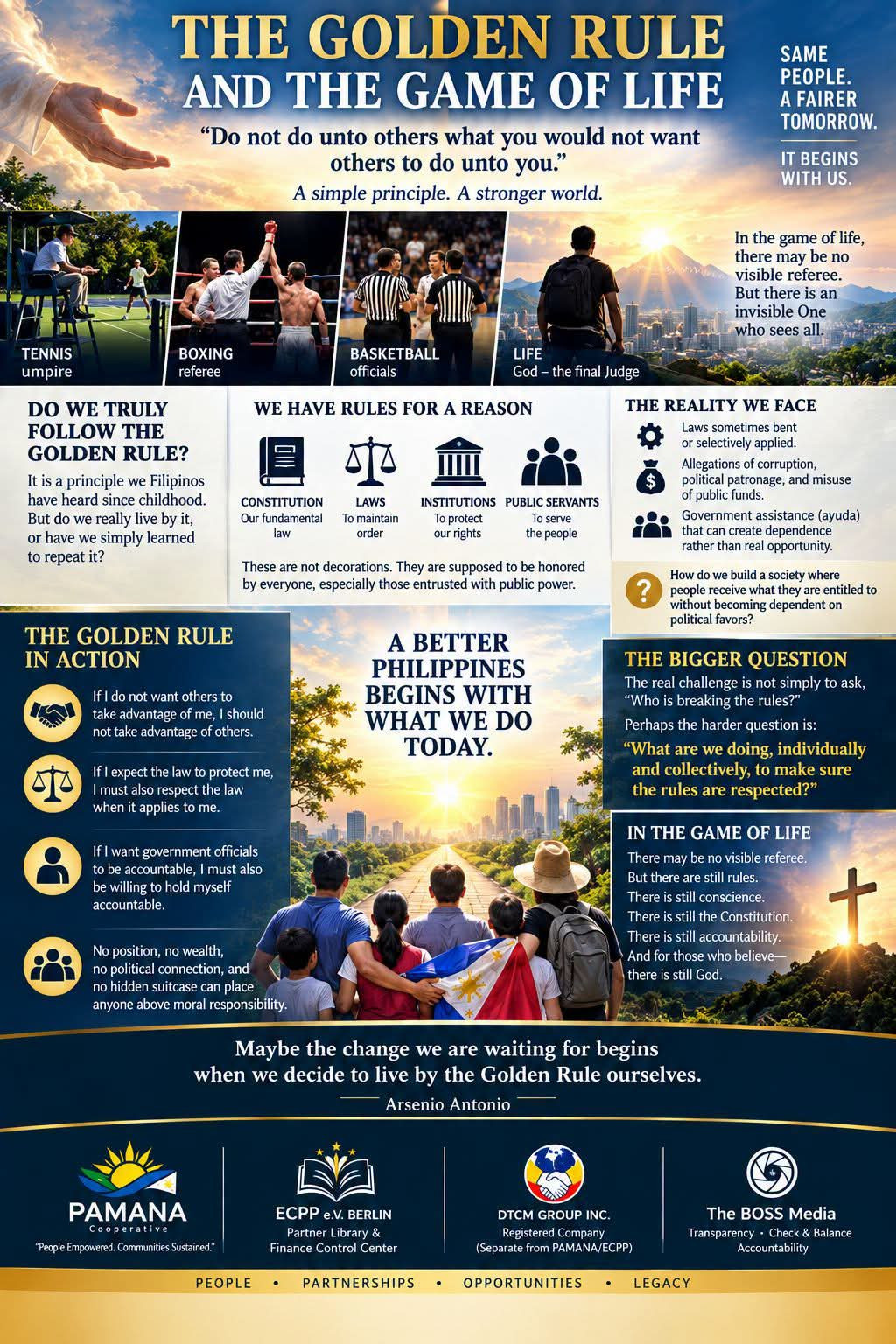
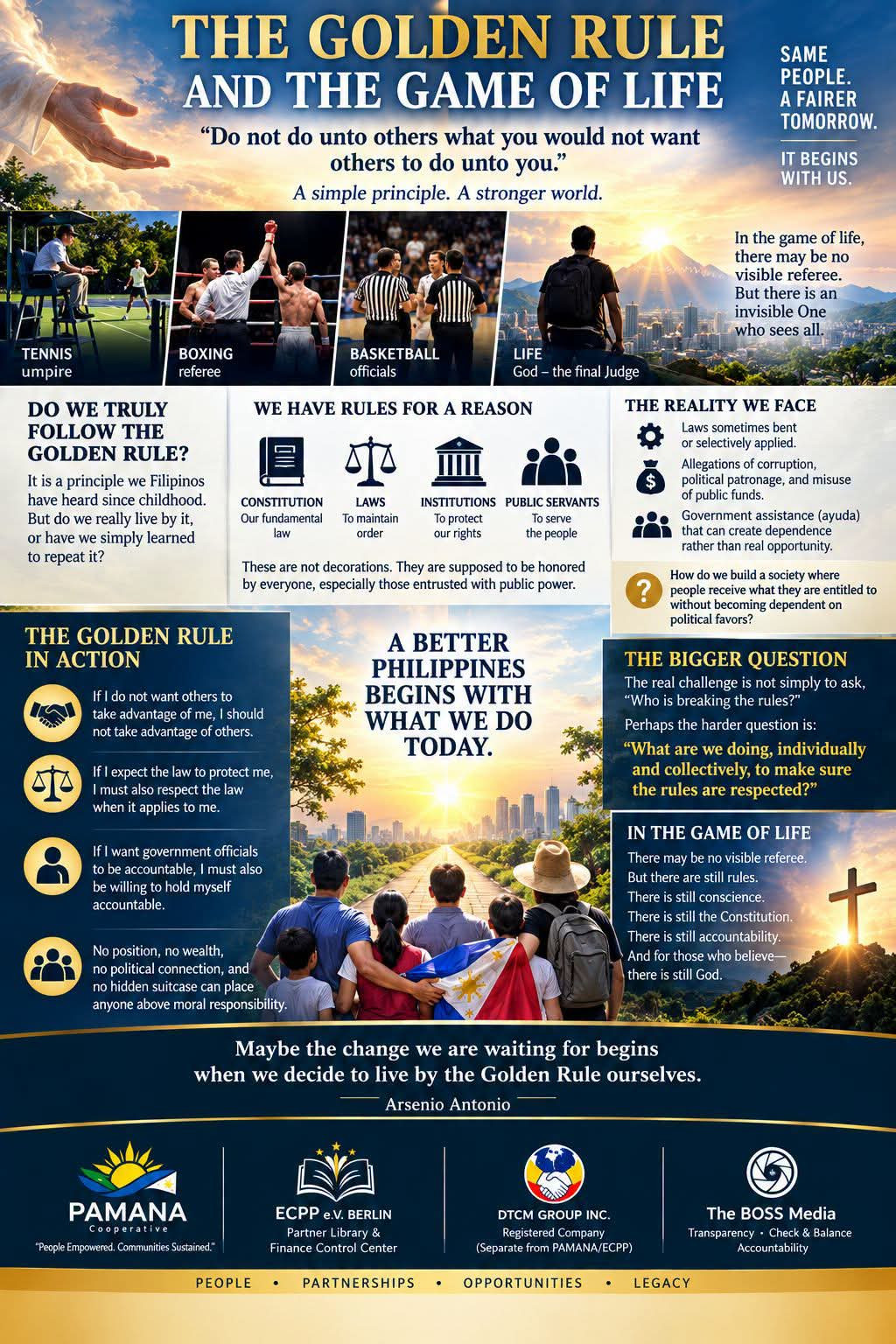
Think about any game. Every game has rules, and every serious game has someone whose responsibility is to see that those rules are followed. In tennis, there is an umpire. In boxing, there is a referee. In basketball, there are officials. And so on.

But what about the greatest game of all—the game of life?

There is no visible referee standing in the middle of the ring. Yet many of us believe that there is an invisible One watching over us: God, whom we ultimately believe to be the final Judge.

But then we have to ask ourselves:

Is that belief reflected in the way we live and govern our society today?

We have a Constitution. We have laws. We have institutions created to protect our rights and maintain order. These rules are not decorations; they are supposed to be honored by everyone, especially those entrusted with public power.

Yet many Filipinos feel that laws are sometimes bent, selectively applied, or used to protect interests that should instead be exposed to public scrutiny.

There are also continuing allegations and public controversies surrounding corruption, political patronage, misuse of public funds, and the distribution of government assistance. At the same time, ordinary people may accept ayuda because they genuinely need help. That reality should not automatically be confused with bribery—but it does raise an important question:

How do we build a society where people receive what they are entitled to without becoming dependent on political favors?

Perhaps this is where the Golden Rule becomes more than a saying.

If I do not want others to take advantage of me, I should not take advantage of others.

If I expect the law to protect me, I must also respect the law when it applies to me.

If I want government officials to be accountable, I must also be willing to hold myself accountable.

And if I believe that God is the final Judge, then perhaps I should remember that no position, no wealth, no political connection, and no hidden suitcase can ultimately place anyone above moral responsibility.

The real challenge is not simply to ask, “Who is breaking the rules?”

Perhaps the harder question is:

“What are we doing, individually and collectively, to make sure the rules are respected?”

Because in the game of life, there may be no visible referee.

But there are still rules.

There is still conscience.

There is still the Constitution.

There is still accountability.

And for those who believe—there is still God.

Maybe the change we are waiting for begins when we decide to live by the Golden Rule ourselves.

image

𝐓𝐡𝐞 𝐆𝐨𝐥𝐝𝐞𝐧 𝐑𝐮𝐥𝐞 𝐚𝐧𝐝 𝐭𝐡𝐞 𝐆𝐚𝐦𝐞 𝐨𝐟 𝐋𝐢𝐟𝐞

“Do not do unto others what you would not want others to do unto you.”

It is a simple principle—the Golden Rule—that we Filipinos have heard since childhood. But the question is: do we truly follow it, or have we simply learned to repeat it?

Think about any game. Every game has rules, and every serious game has someone whose responsibility is to see that those rules are followed. In tennis, there is an umpire. In boxing, there is a referee. In basketball, there are officials. And so on.

But what about the greatest game of all—the game of life?

There is no visible referee standing in the middle of the ring. Yet many of us believe that there is an invisible One watching over us: God, whom we ultimately believe to be the final Judge.

But then we have to ask ourselves:

Is that belief reflected in the way we live and govern our society today?

We have a Constitution. We have laws. We have institutions created to protect our rights and maintain order. These rules are not decorations; they are supposed to be honored by everyone, especially those entrusted with public power.

Yet many Filipinos feel that laws are sometimes bent, selectively applied, or used to protect interests that should instead be exposed to public scrutiny.

There are also continuing allegations and public controversies surrounding corruption, political patronage, misuse of public funds, and the distribution of government assistance. At the same time, ordinary people may accept ayuda because they genuinely need help. That reality should not automatically be confused with bribery—but it does raise an important question:

How do we build a society where people receive what they are entitled to without becoming dependent on political favors?

Perhaps this is where the Golden Rule becomes more than a saying.

If I do not want others to take advantage of me, I should not take advantage of others.

If I expect the law to protect me, I must also respect the law when it applies to me.

If I want government officials to be accountable, I must also be willing to hold myself accountable.

And if I believe that God is the final Judge, then perhaps I should remember that no position, no wealth, no political connection, and no hidden suitcase can ultimately place anyone above moral responsibility.

The real challenge is not simply to ask, “Who is breaking the rules?”

Perhaps the harder question is:

“What are we doing, individually and collectively, to make sure the rules are respected?”

Because in the game of life, there may be no visible referee.

But there are still rules.

There is still conscience.

There is still the Constitution.

There is still accountability.

And for those who believe—there is still God.

Maybe the change we are waiting for begins when we decide to live by the Golden Rule ourselves.

image

𝐓𝐡𝐞 𝐆𝐨𝐥𝐝𝐞𝐧 𝐑𝐮𝐥𝐞 𝐚𝐧𝐝 𝐭𝐡𝐞 𝐆𝐚𝐦𝐞 𝐨𝐟 𝐋𝐢𝐟𝐞

“Do not do unto others what you would not want others to do unto you.”

It is a simple principle—the Golden Rule—that we Filipinos have heard since childhood. But the question is: do we truly follow it, or have we simply learned to repeat it?

Think about any game. Every game has rules, and every serious game has someone whose responsibility is to see that those rules are followed. In tennis, there is an umpire. In boxing, there is a referee. In basketball, there are officials. And so on.

But what about the greatest game of all—the game of life?

There is no visible referee standing in the middle of the ring. Yet many of us believe that there is an invisible One watching over us: God, whom we ultimately believe to be the final Judge.

But then we have to ask ourselves:

Is that belief reflected in the way we live and govern our society today?

We have a Constitution. We have laws. We have institutions created to protect our rights and maintain order. These rules are not decorations; they are supposed to be honored by everyone, especially those entrusted with public power.

Yet many Filipinos feel that laws are sometimes bent, selectively applied, or used to protect interests that should instead be exposed to public scrutiny.

There are also continuing allegations and public controversies surrounding corruption, political patronage, misuse of public funds, and the distribution of government assistance. At the same time, ordinary people may accept ayuda because they genuinely need help. That reality should not automatically be confused with bribery—but it does raise an important question:

How do we build a society where people receive what they are entitled to without becoming dependent on political favors?

Perhaps this is where the Golden Rule becomes more than a saying.

If I do not want others to take advantage of me, I should not take advantage of others.

If I expect the law to protect me, I must also respect the law when it applies to me.

If I want government officials to be accountable, I must also be willing to hold myself accountable.

And if I believe that God is the final Judge, then perhaps I should remember that no position, no wealth, no political connection, and no hidden suitcase can ultimately place anyone above moral responsibility.

The real challenge is not simply to ask, “Who is breaking the rules?”

Perhaps the harder question is:

“What are we doing, individually and collectively, to make sure the rules are respected?”

Because in the game of life, there may be no visible referee.

But there are still rules.

There is still conscience.

There is still the Constitution.

There is still accountability.

And for those who believe—there is still God.

Maybe the change we are waiting for begins when we decide to live by the Golden Rule ourselves.

imageimage

𝐓𝐡𝐞 𝐆𝐨𝐥𝐝𝐞𝐧 𝐑𝐮𝐥𝐞 𝐚𝐧𝐝 𝐭𝐡𝐞 𝐆𝐚𝐦𝐞 𝐨𝐟 𝐋𝐢𝐟𝐞

“Do not do unto others what you would not want others to do unto you.”

It is a simple principle—the Golden Rule—that we Filipinos have heard since childhood. But the question is: do we truly follow it, or have we simply learned to repeat it?

Think about any game. Every game has rules, and every serious game has someone whose responsibility is to see that those rules are followed. In tennis, there is an umpire. In boxing, there is a referee. In basketball, there are officials. And so on.

But what about the greatest game of all—the game of life?

There is no visible referee standing in the middle of the ring. Yet many of us believe that there is an invisible One watching over us: God, whom we ultimately believe to be the final Judge.

But then we have to ask ourselves:

Is that belief reflected in the way we live and govern our society today?

We have a Constitution. We have laws. We have institutions created to protect our rights and maintain order. These rules are not decorations; they are supposed to be honored by everyone, especially those entrusted with public power.

Yet many Filipinos feel that laws are sometimes bent, selectively applied, or used to protect interests that should instead be exposed to public scrutiny.

There are also continuing allegations and public controversies surrounding corruption, political patronage, misuse of public funds, and the distribution of government assistance. At the same time, ordinary people may accept ayuda because they genuinely need help. That reality should not automatically be confused with bribery—but it does raise an important question:

How do we build a society where people receive what they are entitled to without becoming dependent on political favors?

Perhaps this is where the Golden Rule becomes more than a saying.

If I do not want others to take advantage of me, I should not take advantage of others.

If I expect the law to protect me, I must also respect the law when it applies to me.

If I want government officials to be accountable, I must also be willing to hold myself accountable.

And if I believe that God is the final Judge, then perhaps I should remember that no position, no wealth, no political connection, and no hidden suitcase can ultimately place anyone above moral responsibility.

The real challenge is not simply to ask, “Who is breaking the rules?”

Perhaps the harder question is:

“What are we doing, individually and collectively, to make sure the rules are respected?”

Because in the game of life, there may be no visible referee.

But there are still rules.

There is still conscience.

There is still the Constitution.

There is still accountability.

And for those who believe—there is still God.

Maybe the change we are waiting for begins when we decide to live by the Golden Rule ourselves.

image

𝐓𝐡𝐞 𝐆𝐨𝐥𝐝𝐞𝐧 𝐑𝐮𝐥𝐞 𝐚𝐧𝐝 𝐭𝐡𝐞 𝐆𝐚𝐦𝐞 𝐨𝐟 𝐋𝐢𝐟𝐞

“Do not do unto others what you would not want others to do unto you.”

It is a simple principle—the Golden Rule—that we Filipinos have heard since childhood. But the question is: do we truly follow it, or have we simply learned to repeat it?

Think about any game. Every game has rules, and every serious game has someone whose responsibility is to see that those rules are followed. In tennis, there is an umpire. In boxing, there is a referee. In basketball, there are officials. And so on.

But what about the greatest game of all—the game of life?

There is no visible referee standing in the middle of the ring. Yet many of us believe that there is an invisible One watching over us: God, whom we ultimately believe to be the final Judge.

But then we have to ask ourselves:

Is that belief reflected in the way we live and govern our society today?

We have a Constitution. We have laws. We have institutions created to protect our rights and maintain order. These rules are not decorations; they are supposed to be honored by everyone, especially those entrusted with public power.

Yet many Filipinos feel that laws are sometimes bent, selectively applied, or used to protect interests that should instead be exposed to public scrutiny.

There are also continuing allegations and public controversies surrounding corruption, political patronage, misuse of public funds, and the distribution of government assistance. At the same time, ordinary people may accept ayuda because they genuinely need help. That reality should not automatically be confused with bribery—but it does raise an important question:

How do we build a society where people receive what they are entitled to without becoming dependent on political favors?

Perhaps this is where the Golden Rule becomes more than a saying.

If I do not want others to take advantage of me, I should not take advantage of others.

If I expect the law to protect me, I must also respect the law when it applies to me.

If I want government officials to be accountable, I must also be willing to hold myself accountable.

And if I believe that God is the final Judge, then perhaps I should remember that no position, no wealth, no political connection, and no hidden suitcase can ultimately place anyone above moral responsibility.

The real challenge is not simply to ask, “Who is breaking the rules?”

Perhaps the harder question is:

“What are we doing, individually and collectively, to make sure the rules are respected?”

Because in the game of life, there may be no visible referee.

But there are still rules.

There is still conscience.

There is still the Constitution.

There is still accountability.

And for those who believe—there is still God.

Maybe the change we are waiting for begins when we decide to live by the Golden Rule ourselves.

image