𝐓𝐡𝐞 𝐆𝐨𝐥𝐝𝐞𝐧 𝐑𝐮𝐥𝐞 𝐚𝐧𝐝 𝐭𝐡𝐞 𝐆𝐚𝐦𝐞 𝐨𝐟 𝐋𝐢𝐟𝐞
“Do not do unto others what you would not want others to do unto you.”
It is a simple principle—the Golden Rule—that we Filipinos have heard since childhood. But the question is: do we truly follow it, or have we simply learned to repeat it?
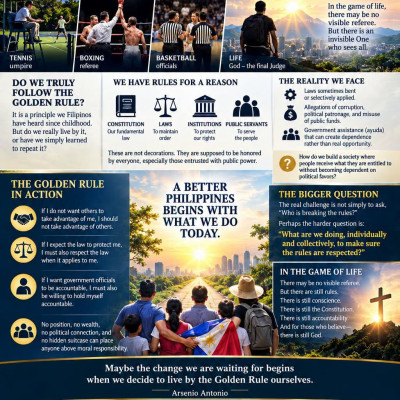
Think about any game. Every game has rules, and every serious game has someone whose responsibility is to see that those rules are followed. In tennis, there is an umpire. In boxing, there is a referee. In basketball, there are officials. And so on.
But what about the greatest game of all—the game of life?
There is no visible referee standing in the middle of the ring. Yet many of us believe that there is an invisible One watching over us: God, whom we ultimately believe to be the final Judge.
But then we have to ask ourselves:
Is that belief reflected in the way we live and govern our society today?
We have a Constitution. We have laws. We have institutions created to protect our rights and maintain order. These rules are not decorations; they are supposed to be honored by everyone, especially those entrusted with public power.
Yet many Filipinos feel that laws are sometimes bent, selectively applied, or used to protect interests that should instead be exposed to public scrutiny.
There are also continuing allegations and public controversies surrounding corruption, political patronage, misuse of public funds, and the distribution of government assistance. At the same time, ordinary people may accept ayuda because they genuinely need help. That reality should not automatically be confused with bribery—but it does raise an important question:
How do we build a society where people receive what they are entitled to without becoming dependent on political favors?
Perhaps this is where the Golden Rule becomes more than a saying.
If I do not want others to take advantage of me, I should not take advantage of others.
If I expect the law to protect me, I must also respect the law when it applies to me.
If I want government officials to be accountable, I must also be willing to hold myself accountable.
And if I believe that God is the final Judge, then perhaps I should remember that no position, no wealth, no political connection, and no hidden suitcase can ultimately place anyone above moral responsibility.
The real challenge is not simply to ask, “Who is breaking the rules?”
Perhaps the harder question is:
“What are we doing, individually and collectively, to make sure the rules are respected?”
Because in the game of life, there may be no visible referee.
But there are still rules.
There is still conscience.
There is still the Constitution.
There is still accountability.
And for those who believe—there is still God.
Maybe the change we are waiting for begins when we decide to live by the Golden Rule ourselves.