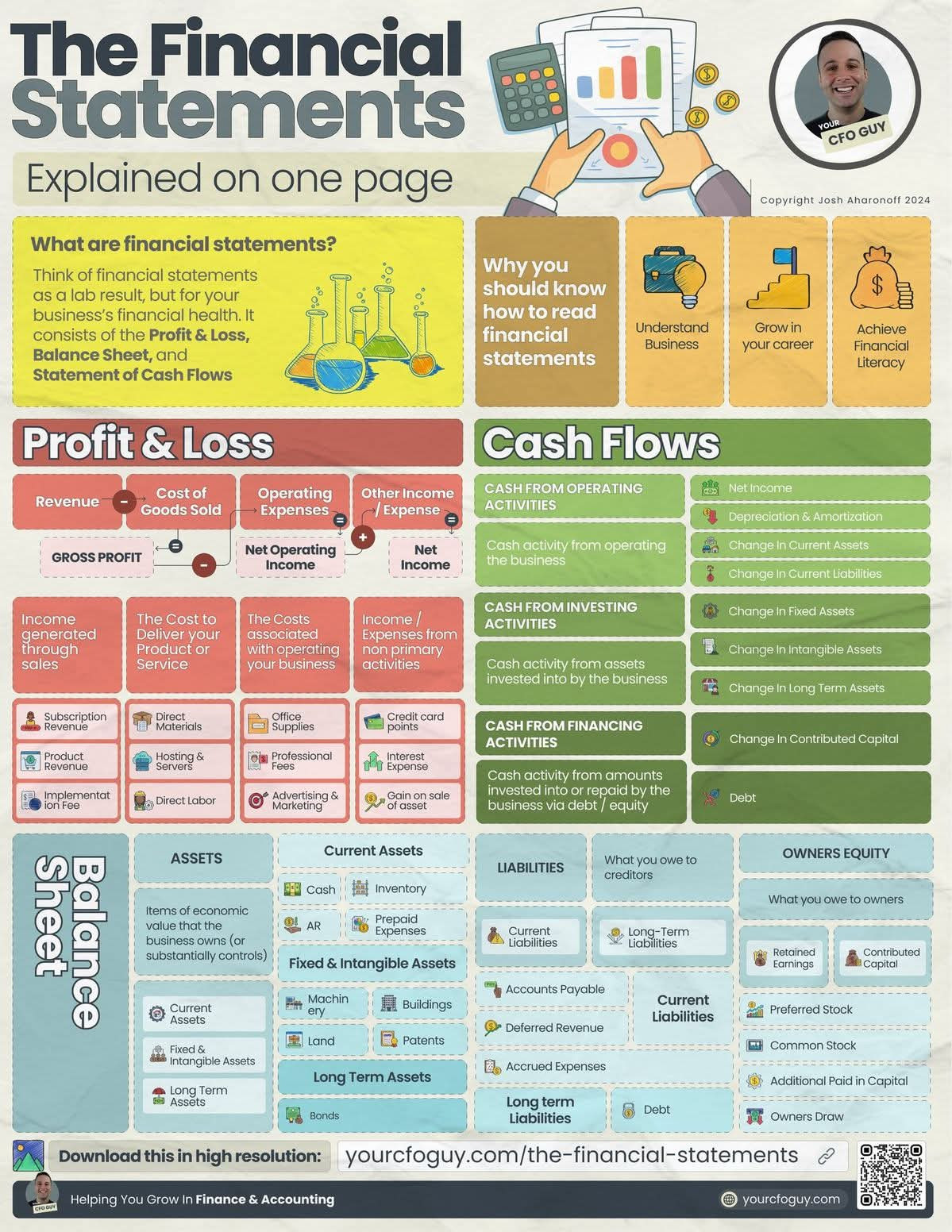
Financial statements are formal records that summarize a company's financial performance and position, providing essential insights into its economic health for stakeholders such as investors, creditors, and management. They are typically prepared according to specific accounting rules like GAAP or IFRS.
The four main types are:
1. Balance Sheet: A snapshot of a company's financial position at a specific point in time, showing assets, liabilities, and shareholders' equity. The accounting equation is Assets = Liabilities + Equity.
2. Income Statement: Reports on a company's financial performance over a period, detailing revenues, expenses, gains, and losses to determine net income or loss.
3. Cash Flow Statement: Tracks cash entering and leaving the business over a period, categorized into operating, investing, and financing activities.
4. Statement of Shareholders' Equity: Shows changes in the equity section of the balance sheet during a reporting period, including items like common stock and retained earnings.
These statements are linked and essential for evaluating a company's stability, performance, and future prospects, helping stakeholders make informed decisions. Publicly traded U.S. companies must file annual reports (10-K) with the U.S. Securities and Exchange Commission (SEC) that include these financial statements.
#fblifestyle #everyone Accounting Knowledge Concepts